
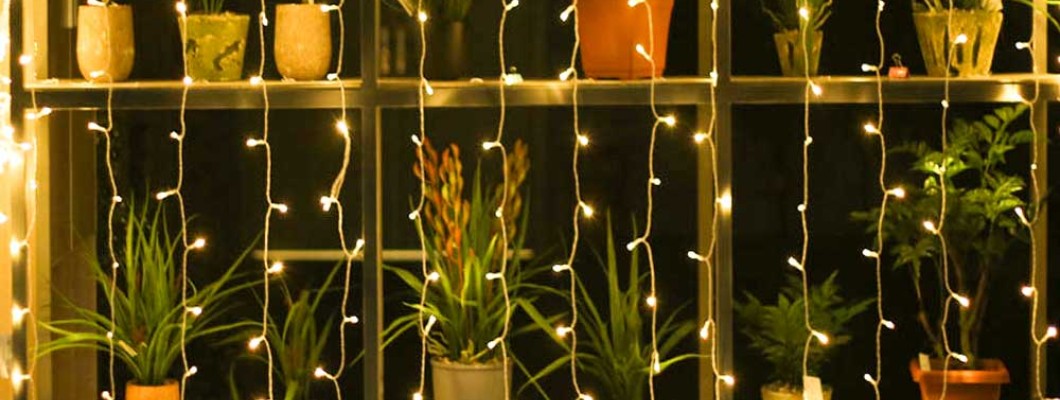
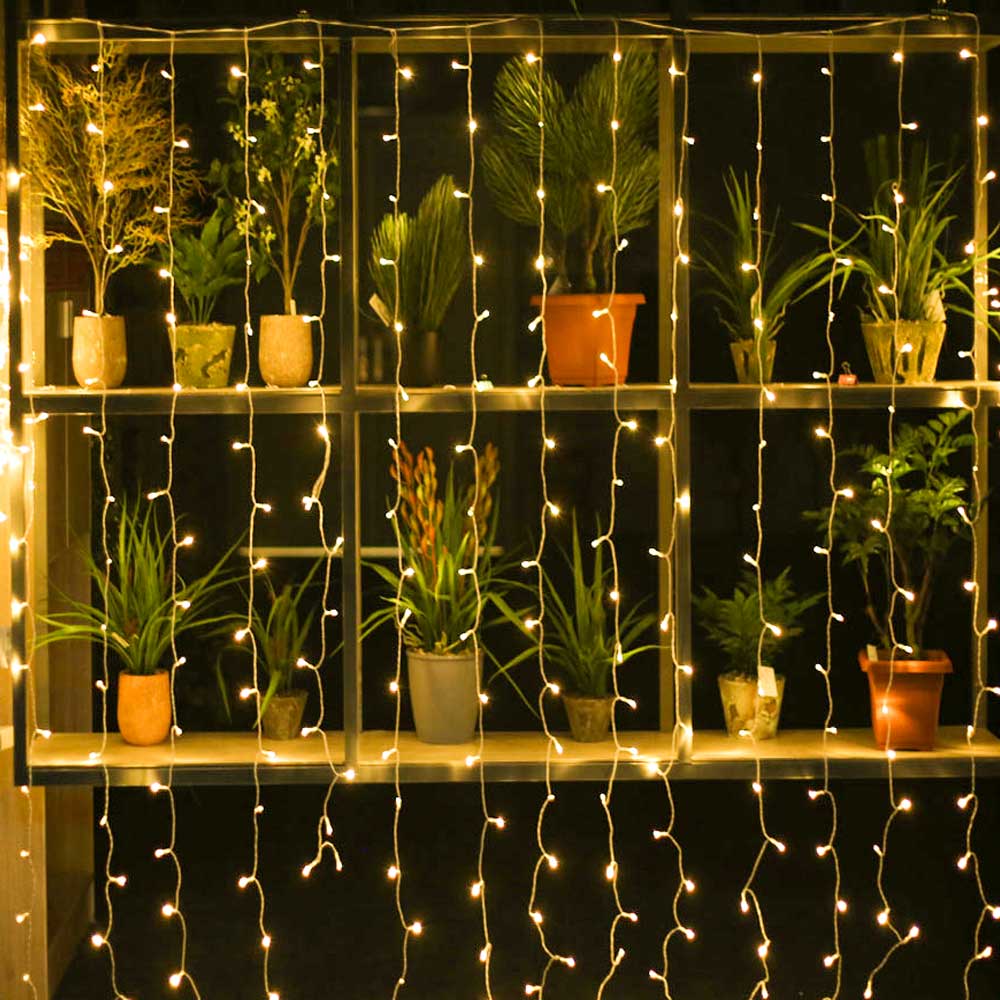
The panel that looks dark at 9pm
Here's a scenario I've watched a dozen times at hospitality install sites: someone buys a 360-LED curtain panel, 9.8ft × 6.6ft, warm white, hangs it across a balcony railing, walks away, and at 9pm with the ambient light down it looks... thin. Not dark-and-dramatic. Thin. Like the string got stretched. And they blame the LED quality. They don't. It was the density math, and nobody did it.
Curtain lights are a different animal than string lights. A string light is linear — you're lighting a line, a rafter edge, a fence top. A curtain light is areal — you're lighting a surface. And surfaces follow a rule that the product page never tells you: perceived brightness is driven by LED density per square meter, not by LED count. A 360-LED panel on a 6.5m² surface is 55 LEDs/m². That's the number that matters. And 55 is the floor, not the target.
The two numbers that decide it
Two specs on the box, and they do all the work. LED count and panel dimensions. Divide one by the other and you get density. That's it. That's the whole analysis.
- ~40 LEDs/m² — visible, but gaps show at night. Fine for a daytime decorative accent, not fine for a balcony that needs to glow at 11pm.
- 55–70 LEDs/m² — the working range. From 4m away the surface reads as a continuous light field, not a grid of dots. This is what you want for a balcony or window display.
- 80+ LEDs/m² — dense enough that the individual LEDs stop being visible at all. The wall of light effect. Overkill for most residential balconies, but this is the range hospitality venues pay for.
Now do it on a real product. A 9.8ft × 6.6ft panel is 3m × 2m = 6m². 360 LEDs ÷ 6m² = 60 LEDs/m². That's mid-range, fine. But here's the trap: the same 360-LED count on a 10ft × 10ft panel (9.5m²) drops to 38 LEDs/m². Same product family, same price bracket, one looks like a light wall, the other looks like a grid. The box says 360. The box doesn't say which panel you're getting. Check dimensions, not counts.
Strand spacing: the second dimension
LED count is the average. Strand spacing is the distribution, and gaps are where the illusion breaks. A well-built curtain panel has vertical strands every 25–30cm. Below 25cm spacing, the vertical "wires" between LEDs become visible from the side, and the curtain reads as lines, not fabric. Above 30cm, the gaps between strands start showing the wall behind them when you look at an angle — which is exactly what a viewer on the street does.
Rule of thumb from the field: strand spacing should be no more than 1/6 of the panel height. On a 2m panel, that's 33cm maximum, and 25cm is comfortable. If you're installing a panel taller than 2.5m, stop — you're past the point where the sag math works out (next section), and you want two panels side by side instead.
Sag: why the bottom 30cm always looks weaker
Every curtain panel sags. The strands are fixed at the top rail and hang free, so gravity pulls the bottom 20–30cm of each strand into a curve. The LEDs in that lower section sit lower than the ones above, which means two things: the lower band of the panel is visibly dimmer in perceived density (the dots are spread apart vertically), and if the panel is near a wall or fence, the sagged strand touches the surface and casts a shadowed line that reads as a dead row.
The fix isn't stiffer wire — it's mounting tension and a shorter effective strand length. Mount the top rail taut (no slack in the horizontal support), and if the panel is over 2m tall, add a mid-point support clip at the 1m mark. That halves the effective free-hang length and cuts the sag roughly in proportion. It's a 30-second install step and it's the difference between "the bottom looks fine" and "the bottom looks broken."
For a deeper look at what makes a panel read as a solid light field versus a grid of dots, see our LED lighting range — the spec sheets there list strand spacing and panel dimensions explicitly, which is exactly what you need before you buy.
IP44 is a number, not a guarantee
Every outdoor curtain panel sold in Europe carries IP44. That means: protected against solid objects 1mm and larger, and against splashing water from any direction. It does not mean "rains in the middle of a downpour for four hours without consequences." It means "a splash, a light shower, a balcony that gets mist but not a direct rain column."
Where IP44 curtain panels fail in practice is at the connector junctions — the point where the panel's power lead plugs into the transformer or adapter. That's the one point on the panel that isn't molded, it's a mechanical connector, and it's where water gets in when the panel is hung vertically and rain runs down the top rail and pools at the junction. If your balcony gets a direct rain column, the connector is the thing that fails, not the LEDs. The LEDs are fine; the junction corrodes, the panel flickers, then dies, and you've lost the whole run because the connector failed at one point.
The fix is simple and costs nothing: route the power lead away from the top rail, so it exits the panel from the bottom corner, not the top. Water runs down, the lead runs down on the outside of the junction, and the splash that hits the connector is the initial rain, not a pooled runoff. If the panel comes with the lead exiting the top, you're going to have a dead panel by the second wet season. That's not a warranty problem, that's a geometry problem.
The modes question, answered once
Every panel ships with 8 modes. Steady, twinkle, chase, wave, jump, fade, slow-rise, fast-fade. For a permanent balcony or window installation, steady warm-white (2700K) is the only mode you should be running 90% of the time. Twinkle reads as a party; a party doesn't last 12 hours a night. Chase reads as a store front; a store front wants a storefront, not a balcony. Fade is fine for an hour before a dinner party, then switch back to steady.
The 2700K color temperature matters more than most people realize. At 2700K, warm white reads as "candlelight" from 4m away — it harmonizes with the warm glow of interior lighting showing through a window. At 3000K or above, it starts reading as "office" or "utility" from the same distance, and the whole installation looks colder than the room it's next to. If your interior is warm white, match it. If your interior is mixed, 2700K on the outside is the safer default.
If you're building a full evening setup, the pairing that works in practice is curtain lights on the vertical plane (balcony, window, fence) with a flameless candle setup on the horizontal plane (rail, table, ledge). The vertical plane gives the ambient field; the candles give the focal points. That's the composition that actually reads as "designed" from the street, rather than "we put lights on the balcony."
How many panels do you actually need?
The mistake is buying one panel and centering it. A balcony 3m wide with a single 2m panel leaves 0.5m on each side unlit, and the lit section reads as a rectangle pasted onto an unlit wall. The rule: cover at least 80% of the width, or the whole width. For a 3m balcony, that's two 1.5m panels or one 2m panel plus a 1m accent run. The 80% threshold is where the eye stops registering the edges and starts reading the surface as a field.
If the balcony is over 4m wide, you're in "two or three panels" territory, and at that point you're also in "do you want a timer" territory — because you're now running 3–5 panels simultaneously, and a 12-hour unattended timer on a 4-panel setup is 4× the draw of one panel. Check the total wattage before you commit to the timer; most adapters on these panels are 24V 2A, which caps out around 48W, and 4 panels at 12W each is right at the edge of that.
The spec sheet you should ask for
Before you buy, ask for these four numbers. Not the marketing numbers — the spec sheet numbers:
- LED count per panel (not per meter, per panel)
- Panel dimensions in meters, height × width
- Strand spacing in cm
- Color temperature in Kelvin, and the wattage of the included adapter
If the seller can't give you all four, you're buying a lottery ticket. The product page will give you the first two. The strand spacing and the adapter wattage are the ones that separate a panel that works from a panel that fails in the second winter.
FAQ
FAQSCHEMA_PLACEHOLDERHow many LED curtain lights do I need for a balcony?
Divide your balcony width by the panel width, aim for at least 80% coverage. A 3m balcony needs two 1.5m panels or one 2m panel plus a 1m run. Check LED density: 55–70 LEDs/m² is the working range for a balcony that should glow at night, not just be visible.
Are IP44 curtain lights safe in the rain?
IP44 handles splashes and light showers. It does not handle a direct rain column for extended periods. The failure point is the power connector junction, not the LEDs. Route the power lead from the bottom corner of the panel, not the top, and the junction stays dry in most weather patterns.
What color temperature should I use on an outdoor balcony?
2700K warm white. It reads as candlelight from 4m away and harmonizes with interior lighting showing through a window. At 3000K or above it starts reading as utility lighting from the same distance.
Why does the bottom of my curtain panel look dimmer?
Sag. The strands are fixed at the top and hang free, so the bottom 20–30cm curves downward under gravity, spreading the LEDs vertically and reducing the perceived density in that band. Add a mid-point support clip at the 1m mark on panels over 2m tall to cut the sag roughly in half.
How do I know if a curtain light panel is good quality before buying?
Ask for strand spacing in cm and the adapter wattage. Strand spacing under 30cm is the quality threshold — above that, the gaps between strands show the wall behind them from an angle. Adapter wattage should be at least 2× the total LED wattage of the panel to give headroom for a timer or future expansion.
Leave a Comment